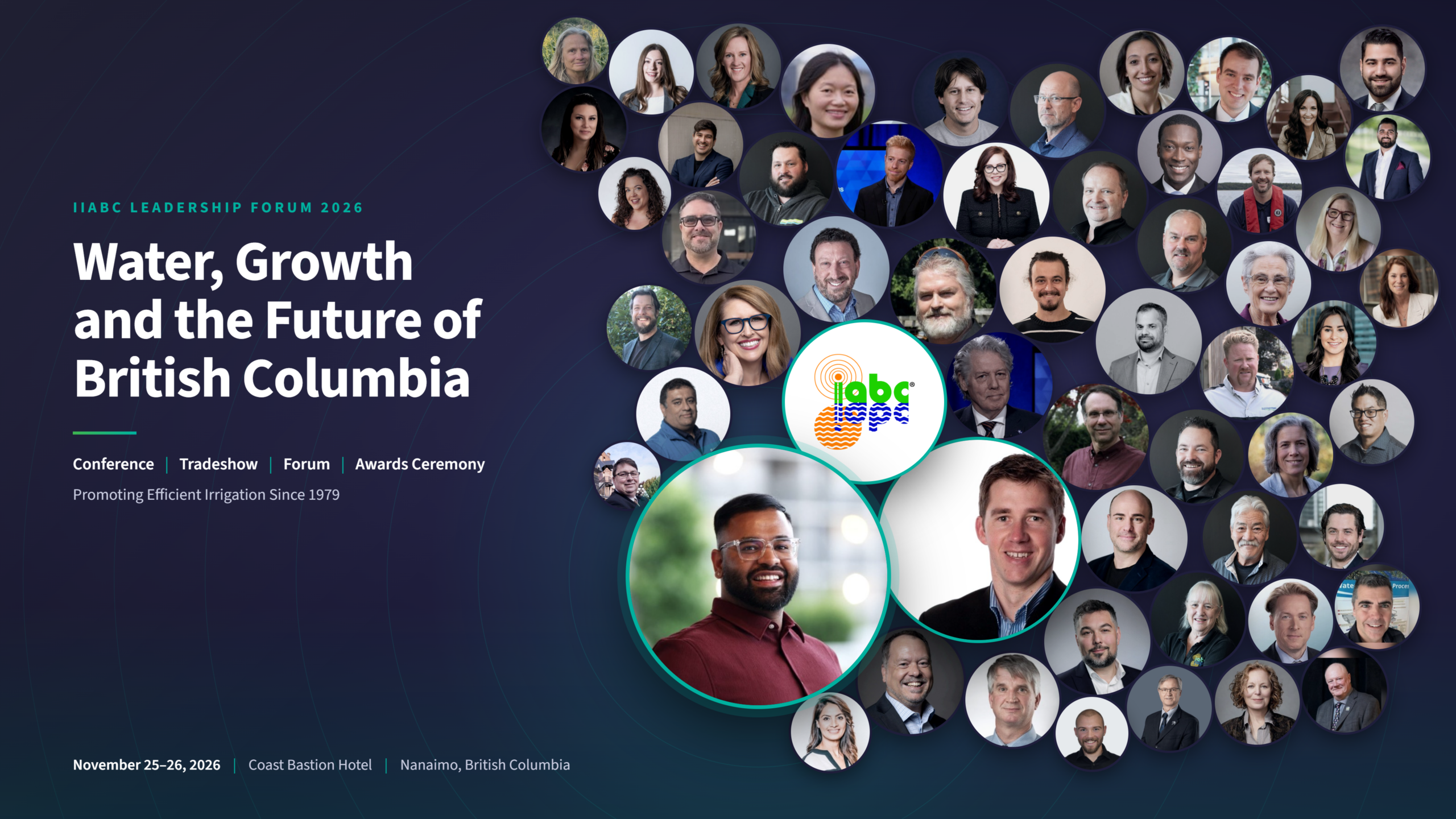
Nine provincial panels bring together elected leaders, the Chief Commissioner of the BC Treaty
Commission, the province’s business, agriculture and research communities, and veteran political journalists
and the professionals who build British Columbia’s water systems, November 25 and 26 at the Coast
Bastion Hotel
NANAIMO, B.C. Who gets water when there is not enough to go around? Does British Columbia have a
What plan for the resource on which its farms, communities, and economy depend? Can the province keep
growing without breaking the systems that sustain it, and who will feed British Columbians in 2050?
Next week, those questions move to the center of the provincial conversation as the irrigation industry
Association of British Columbia (IIABC) convenes the inaugural IIABC Leadership Forum 2026, Water,
Growth and the Future of British Columbia, on Wednesday, November 25, and Thursday, November 26
at the Coast Bastion Hotel in Nanaimo.
For the first time, an elected member of the Legislative Assembly, a mayor, and municipal leaders, the
Chief Commissioner of the BC Treaty Commission, the province’s leading business and agricultural
voices, researchers from universities across the province, one of the province’s most seasoned political
correspondents, technology founders, farmers, and the designers, technicians, and contractors who keep
Water moving across the province will share a single stage. Across nine provincial panels, keynote
addresses and fireside conversations, more than 40 leaders will examine the decisions that will shape
British Columbia for a generation. The Forum is the centrepiece of the IIABC 2026 Annual Conference
and is open to delegates in person in Nanaimo and by live stream from anywhere in the province.
“Prolonged drought, shifting precipitation, rapid population growth, and mounting pressure on our
watersheds now demand a more deliberate, evidence-based, and collaborative approach to how British
Columbia allocates, values, and conserves its water,” said Nigel Pedersen, president of IIABC, in
remarks prepared for the forum’s opening. “Since 1979, our association has represented the designers,
technicians, contractors, suppliers, and growers who deliver water where it is needed most. Yet the
questions before us today extend far beyond our own industry.”
A PROVINCE AT A TURNING POINT
British Columbia is entering a decade in which water will define its prosperity. Recurring drought,
wildfire, changing precipitation, rapid population growth, rising costs, and a deepening shortage of
Skilled trades are converging on the same finite resource. Less than 20 percent of the province’s farmland
is irrigated, yet that land produces more than 65 per cent of British Columbia’s food value. How the
province plans, shares, prices, governs, and protects its water will determine the security of its food.
supply, the affordability of its communities and the competitiveness of its economy.
“Water is the foundation of everything British Columbians value: the food on our tables, the strength of
our communities and the future of our economy,” said Poshak Sachdeva, Executive Director of IIABC.
“For too long, the conversation about water has taken place in separate rooms. This forum brings
government, industry, researchers, local leaders, and Indigenous voices together, because the choices
ahead of us are too important to be made in isolation. Every British Columbian has a stake in the
answers.”
OPENING IN THE SNUNEYMUXW TERRITORY
The forum opens on the morning of Wednesday, November 25, with a territorial welcome on the
traditional and unceded territory of the Snuneymuxw First Nation, followed by welcome remarks from
Nigel Pedersen; Poshak Sachdeva; and George Anderson, MLA for Nanaimo-Lantzville. Stuart McNish,
Host, Moderator, and Executive Producer of Conversations Live and one of British Columbia’s most
respected journalists and interviewers, then sets the provincial context in the Forum’s opening address,
and Rebecca Vigelius, founder of RVI Coaching and Advisory, introduces delegates to the Forum’s
Nervous System Reset.
DAY ONE: UNDERSTANDING BRITISH COLUMBIA
The first day confronts the hardest questions in provincial water policy. In Who Gets Water?, moderated
by Dr. Alex Glaros of the Food and Agriculture Institute at the University of the Fraser Valley, Mayor
Vickey Brown of the Village of Cumberland, and Bill Hardy, co-owner of Grow and Gather Garden
Centre and Mike Squire, Manager, Water Resources at the City of Nanaimo, examine how a finite supply
is shared among farms, communities, industry, and ecosystems when there is not enough for everyone.
Does British Columbia Have a Water Plan? moderated by Steve Coleman, president of Sterica
Leadership Developers Inc. brings together Dr. Deborah Curran, a professor at the Environmental Law
Centre at the University of Victoria, Councillor Tricia Brett of the District of Lake Country, and Dr.
Lauren Touchant, Chair and Professor of Political Studies at Vancouver Island University, to test whether
The province’s approach to water planning matches the scale of the challenge.
In Is Water the New Oil?, again moderated by Dr. Glaros, Dr. Oliver Brandes, co-director of the POLIS
Water Sustainability Project at the University of Victoria, Bruce Carter, President and CEO of WES-
Tech Irrigation Systems Ltd. and Katy Ehrlich, owner and operator of Alderlea Biodynamic Farm, ask
whether water is becoming British Columbia’s most strategic resource, and what that means for the
people who grow, build, and invest in this province.
Day One closes with Can British Columbia Grow Without Breaking?, moderated by award-winning
business growth coach Patrick von Pander of CRG Consulting Resources Group and MacKay CEO
Forums, in which economist Dr. Roslyn Kunin and Paul Pryce, Director of Policy and Government
Relations at the BC Agriculture Council and Kerriann Coady, Chief Executive Officer of the Canadian
Home Builders’ Association Vancouver Island examines how housing and population and economic
growth can proceed without overwhelming the water and infrastructure on which they depend.
The day also features Terry Ormrod, Area Specification Manager, Western Canada, for The Toro.
Company, on The Water Truth; Steve Mark, Director of Strategic Operations and Innovation at BC 1
Call, and Donna Grant, President of BC 1 Call, on how a quarter century of geospatial data sharing has
built stronger communities and better decisions; Dr. Stewart Cohen, Climate Change Adaptation and
Sustainability Advisor at Royal Roads University, on the decisions the province cannot afford to delay;
and a fireside conversation with Leigh Lampert, CEO and Founding Lawyer of Lampert LawGiC, on
law, business, and the cost of getting it wrong.
DAY TWO: SHAPING THE FUTURE
The second day turns from diagnosis to direction. Dr. Alex Glaros opens with a featured talk asking
whether food security can exist without water security. In British Columbia, Is It Becoming Too Expensive?
to Compete?, moderated by Dr. Rahul Singh, Director of the BC Centre for Agritech Innovation at
Simon Fraser University, Aaron Aerts, Vice President, Policy, at the Business Council of British
Columbia, Harry Jani, Principal of Jani CPA Ltd., and Alex Mitchell, Chief Executive Officer of the
Abbotsford Chamber of Commerce examines costs, regulation, and investment and what it will take to
Keep the province’s businesses, farms, and communities competitive.
Politics, Power, and Public Trust, moderated by Leigh Lampert, brings together Rob Shaw, Political
Correspondent for CHEK News and Glacier Media; Dr. George Abbott, Chief Commissioner of the BC
Treaty Commission and a former provincial cabinet minister; Rachael Segal, founder and president of
Beyond a Ballot, and Dr. Michael MacKenzie, Jarislowsky Chair in Trust and Political Leadership at
Vancouver Island University to explore how decisions about shared resources are made and how public
Trust is earned and kept in the weeks after a provincial election.
In The Great Labour Shortage, moderated by Steve Coleman, Aman Gill, franchise owner of Express
Employment Professionals, Kathy Whitcher, Director, Advocacy and Strategic Relations at the
Vancouver Island Construction Association, and Paul Pryce of the BC Agriculture Council confront the
workforce gap that threatens the province’s ability to build, maintain, and modernize its water systems.
AI Is Here: Who Wins, Who Gets Left Behind?, moderated by Dr. Rahul Singh, features Tristan Taylor,
Founder and Director of the Canadian AI Advancement Institute; Jay Jani, Principal of Jani CPA Ltd.;
Susan Friesen, founder of eVision Media, and Jennifer Hufnagel, AI Educator and AI Readiness
Consultant at Hufnagel Consulting, who will ask how artificial intelligence is reshaping work and
decision-making, and how British Columbia’s organizations can ensure no one is left behind.
The Forum’s concluding panel, BC 2050: Who Will Feed British Columbia?, moderated by Alex
Mitchell looks a generation ahead. Dr. Rahul Singh, Paul Pryce, and Omri Haiven of the Clean Energy
Research Group at Simon Fraser University, Dr. Timothy Green, Professor of Fisheries and Aquaculture
at Vancouver Island University, and Katy Ehrlich will consider how farming, technology, energy, and
Land use must evolve if British Columbia is to feed itself in 2050.
Day Two also includes an executive masterclass on modern networking with Patrick von Pander, a
featured leadership talk on leading through the AI shift with Susan Friesen, a featured talk on agrivoltaics
and community energy with Omri Haiven, and a closing fireside, What We Heard, with Steve Coleman,
before Nigel Pedersen and Poshak Sachdeva deliver the Forum’s closing remarks.
“I invite each of you to listen generously, to question rigorously and to leave with commitments, not
merely conversations,” Pedersen will tell delegates as the Forum opens.
A TRADESHOW OPEN TO THE PUBLIC
On November 25 and 26, from 10:00 a.m. to 4:00 p.m. each day, the IIABC Tradeshow brings
manufacturers, distributors, suppliers, and service providers from the irrigation, water management,
landscape and agricultural technology sectors to the Coast Bastion Hotel. The tradeshow is open to the
public, giving growers, municipal staff, landscape and construction professionals, students, and residents
of Nanaimo and the wider island, a firsthand look at the technologies helping British Columbia do more
with every drop.
HONOURING THE PEOPLE BEHIND THE WATER
On the evening of Wednesday, November 25, the IIABC Awards Ceremony and Dinner takes place in
the Bastion Grand Hall, hosted by Masters of Ceremonies Ashley McDougall of Impact Public Affairs
and Steve Coleman. Recipients will be announced on stage that evening. On Thursday, November 26,
following the IIABC Annual General Meeting, the President’s Reception, hosted by Nigel Pedersen,
brings delegates, speakers, exhibitors, sponsors, and invited guests together to close the forum.
“Behind every efficient system, every conserved litre, and every thriving landscape or harvest stands a
professional whose expertise, integrity, and quiet perseverance make that outcome possible,” Pedersen
said in his prepared remarks for the ceremony.
BUILDING BRITISH COLUMBIA’S WATER WORKFORCE
Throughout the Annual Conference, from November 25 to 27, IIABC delivers in person professional
training and certification at the Coast Bastion Hotel, including Certified Irrigation Technician Level 1,
Level 2 Landscape and Agriculture programs, electrical troubleshooting and irrigation design courses,
with certification exams held on site. These programs build the qualified workforce British Columbia
needs to design, install and maintain efficient water systems in every region of the province.
AT A GLANCE
Event: IIABC Leadership Forum 2026, Water, Growth and the Future of British Columbia, the
centrepiece of the IIABC 2026 Annual Conference
Dates: Wednesday, November 25 and Thursday, November 26, 2026 (Annual Conference and
certification courses, November 25 to 27)
Venue: Coast Bastion Hotel, 11 Bastion Street, Nanaimo, British Columbia, on the traditional territory of
the Snuneymuxw First Nation
Format: Hybrid, in person in Nanaimo or by live stream
Public tradeshow: November 25 and 26, 10:00 a.m. to 4:00 p.m., free and open to the public
Registration: In person registration is $509 for IIABC members and $799 for non-members, with a One
Day Pass at $300, plus applicable taxes, and includes the full programme, tradeshow, Forum meals, the
Awards Ceremony dinner and the President’s Reception. Group and live stream registration are available
through the IIABC office.
Forum information and registration: irrigationbc.com/2026forum
Conference courses: irrigationbc.com/2026forum/courses
MEDIA ACCREDITATION AND INTERVIEWS
Members of the media are invited to attend the Forum, the public tradeshow and the IIABC Awards
Ceremony. Interviews with Nigel Pedersen, Poshak Sachdeva and Forum speakers can be arranged
before and during the event, and photographs and biographical information are available on request.
Media wishing to attend are asked to contact the IIABC office in advance so that accreditation can be
arranged.
ABOUT THE IRRIGATION INDUSTRY ASSOCIATION OF BRITISH COLUMBIA
Founded in 1979, the Irrigation Industry Association of British Columbia (IIABC) is the provincial
association representing irrigation designers, technicians, contractors, manufacturers, distributors and
growers. IIABC advances professional standards, education and certification, and promotes responsible
water management across British Columbia’s agricultural, landscape and municipal sectors.